










Picture this.
It's a Sunday afternoon. Your child is sprawled on the couch, phone in hand, thumb scrolling at warp speed. You've asked twice already. "Go do something." And they've nodded — twice — without moving a muscle.
Now picture this instead.
The same child. Same Sunday. But this time they're hunched over the kitchen table, safety goggles slightly crooked, carefully measuring a liquid into a test tube. They don't hear you walk in. They're completely absorbed. And when the reaction fizzes and bubbles over, they look up — not at a phone, not at a screen — but at you, with the kind of wild-eyed excitement that reminds you exactly why childhood is so extraordinary.
That's what a great science experiment kit does. And that's exactly what this guide is about.
Whether you're searching for a science kit for a curious 6-year-old taking their first steps into discovery, or a mega science kit for a 14-year-old who wants to build actual working models — you're in the right place. Let's find the perfect match.
Why Science Kits Have Become Every Parent's Secret Weapon
Here's the honest truth.
Most parents don't buy science kits because they've done deep research into STEM pedagogy. They buy them because they're desperately looking for something — anything — that will engage their child for more than twenty minutes without a screen.
And science kits deliver. Consistently. Reliably. Almost every time.
But there's actually something much more significant happening when a child sits down with a science experiment kit. The screen-free time is the side effect. The real outcome is something far more valuable: a child who is learning to think like a scientist.
What does that mean in practice?
It means forming a hypothesis before testing something. It means observing carefully rather than jumping to conclusions. It means asking "why did that happen?" instead of accepting things at face value. It means tolerating failure — because experiments don't always work the first time — and trying again with a different approach.
These are not just science skills. These are life skills. And science kits are one of the most efficient ways to build them in children aged 5 to 15.
Science Kits by Age: Matching the Right Kit to the Right Child
Not all science kits are created equal. The biggest mistake parents make is buying a kit that's either too simple (boring in five minutes) or too advanced (frustrating in ten). Here's a practical breakdown by age.
My First Science Kit: Ages 4–6
For children in this age group, the goal isn't chemistry or physics. The goal is wonder.
A first science kit should introduce the idea that the world is full of surprising things — that mixing two harmless substances can make something bubble, that light can split into colours, that a magnet can move things without touching them.
Kits at this level should have large, easy-to-handle components, very simple instructions with visuals rather than text, and experiments that deliver a satisfying result in under five minutes. The "wow" needs to come fast, because attention spans at 4–6 are real.
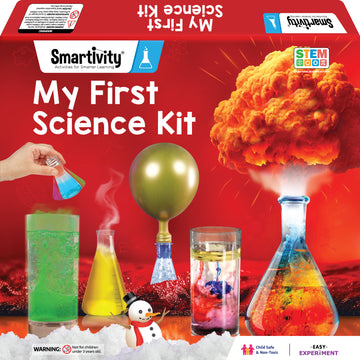
Smartivity's My First Science Kit is designed precisely for this window. It's the beginning of a scientific journey — simple enough for little hands, surprising enough for big imaginations.
Science Experiment Kit for 6–8 Years
At 6 to 8, children are ready for a step up.
They can follow multi-step instructions. They can wait a few minutes for a result. They're starting to ask "why does this happen?" rather than just "what happened?" — which is actually the more important question.
Science experiment kits for this age should start introducing basic scientific concepts: density, chemical reactions, states of matter, magnetism. The experiments should still deliver visible, exciting results — coloured eruptions, things that glow, objects that float or sink — but there should be an explanation that goes with each one.
This is the age where curiosity becomes a habit, if it's nurtured right. Get this window right and you've set a trajectory.
Science Kit for Boys and Girls 8–12 Years
Here's where things get genuinely interesting.
Between 8 and 12, children are cognitively capable of understanding real scientific principles. They can hold multi-step processes in mind. They can record observations, compare results, and draw conclusions. They are, in every meaningful sense, ready to do real science.
A science kit for boys or girls in this age range should offer experiments across multiple disciplines — chemistry, biology, physics, electronics. It should explain the science behind each experiment, not just the steps. And it should have enough experiments to sustain interest over weeks, not just an afternoon.
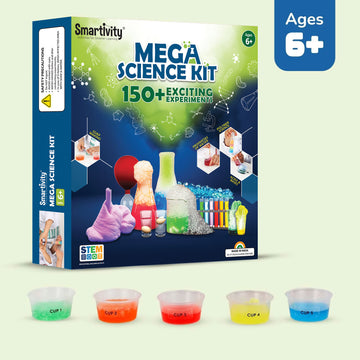
The Smartivity Mega Science Kit is built for this bracket. With a broad range of experiments spanning multiple scientific principles, it's designed to keep an 8–12-year-old genuinely occupied and genuinely learning.
Science Kit for Boys 12–15 Years
This is the bracket that surprises most parents.
Teenagers are often written off as impossible to engage with educational toys. But here's the thing: a 13 or 14-year-old who gets a science kit that actually respects their intelligence will engage with it deeply. The key is that it has to be real. No dumbed-down instructions, no baby-safe approximations of science. Real experiments, real outcomes, real explanations.
Science kits for boys aged 12–15 — and girls in this range, though they're undersearched — should involve working models, electronics, structural engineering, chemistry at a level that connects to what they're studying in school. When a science kit reinforces what a child is learning in class, it goes from being a toy to being a genuine academic tool.
Most parents don't realise that a well-designed science kit can actively improve a 13-year-old's exam performance in physics or chemistry. That's a different value proposition than "keep them off screens for an afternoon."
Science Project Working Models: A Category Worth Understanding
Let's talk about something specific.
Science project working model is one of the most searched terms in this entire category — over 53,000 searches per month. And it's being searched almost exclusively by students (or their parents) looking for something to submit for a school science exhibition.
This is a distinct buyer. They're not looking for open-ended exploration. They're looking for a project that works, looks impressive, demonstrates a real scientific principle, and can be explained clearly to a teacher or judge.
Smartivity's mechanical build kits and science working model kits are ideal for this use case. They produce visible, functional outputs — a working model of a pulley system, a functional electronic circuit, a mechanical demonstration of a scientific law — that tick every box for a school project submission.
If you're a parent reading this in the weeks before your child's science exhibition: this is your answer.
Volcano Science Kit: The Classic That Never Gets Old
Let's address the volcano.
It's been the iconic science experiment for decades. Baking soda and vinegar, fizzing and erupting over a papier-mâché mountain. Every child has done some version of it. And yet — it never stops being magical.
Why? Because chemical reactions are inherently dramatic. Something changes before your eyes. There's a before and an after, and the transformation is visible and exciting in a way that most learning experiences aren't.
A good volcano science kit goes beyond the basic eruption, though. It explains why the reaction happens — the chemistry of acid and base, the production of carbon dioxide, the reason the fizzing occurs. It offers variations: different amounts, different additives, different results. And it connects the experience to real volcanic science — what actually happens when a volcano erupts, why lava flows the way it does.
Done well, a volcano kit is not just an experiment. It's an entry point into earth science, chemistry, and the scientific method simultaneously.
Glow in the Dark Science Kit: Where Night-Time Becomes a Lab
Here's a kit that deserves more attention than it gets.
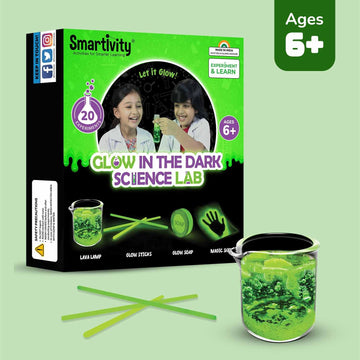
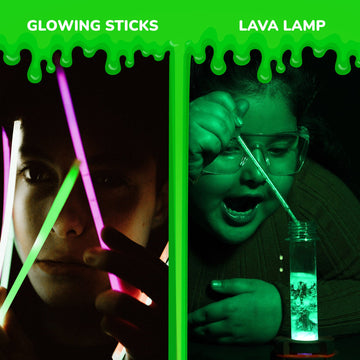
The glow in the dark science kit — and specifically Smartivity's Glow in the Dark Science Lab — taps into something that never fails with children: the dark is fascinating. Things that glow in the dark feel like magic, even to adults.
But what's actually happening is photoluminescence — the absorption of light energy and its slow re-emission in darkness. This is a real and fascinating area of physics and chemistry, and a glow-in-the-dark kit can explain it in a way that makes total sense to a 9-year-old.
More than that, experiments that need to be done in the dark create a natural sense of occasion. The lights go out, and suddenly the kitchen table becomes a laboratory. That theatrical element is not a gimmick — it's genuine engagement.
Electro Play Lab: The Smartivity Kit for Young Engineers
Let's talk about the Smartivity Electro Play Lab specifically.
This kit is for children who are less drawn to chemistry and more fascinated by how things work. Circuits, switches, electricity, and electronics — the building blocks of every device they interact with daily.
Understanding basic electronics is increasingly a fundamental life skill. Not because every child will become an electrical engineer, but because we live in a world entirely dependent on electronic systems, and a basic intuitive understanding of how those systems work is genuinely valuable.
The Electro Play Lab introduces these concepts through hands-on experimentation — building real circuits, seeing how switches work, understanding conductors and insulators. It's one of those kits where the "educational" label is the least interesting thing about it. Children just think they're building cool stuff. And they are.
What Makes Smartivity Science Kits Different
There are a lot of science kits on the market. So why Smartivity?
Here's the short version: most science kits give you experiments. Smartivity gives you understanding.
The difference matters. An experiment that produces a result without explaining why it happened is entertainment. An experiment that produces a result and then walks a child through the science of why it happened is education. Smartivity kits are built around the second model.
Every kit in the Smartivity science range includes clear, age-appropriate scientific explanations alongside each experiment. Not lectures — accessible, interesting explanations that make the science feel as exciting as the experiment itself.
Beyond that, Smartivity kits are built to Indian quality and safety standards, designed with the Indian school curriculum in mind — which means experiments often connect directly to what children are studying in class — and sourced and assembled domestically.
For parents who care about quality, educational rigour, and value — Smartivity sits in a category of its own.
How to Choose the Right Science Kit: A Parent's Decision Framework
Still not sure which kit is right? Here's a quick decision framework.
- Start with age, not interest. A 7-year-old who "loves science" still needs a kit designed for 6–8 year olds. Developmental stage matters more than enthusiasm.
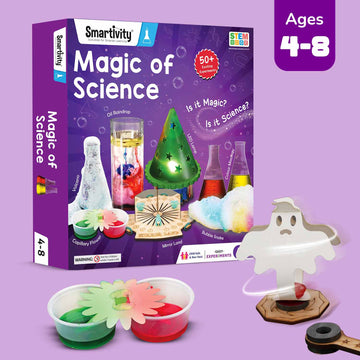
- Consider the occasion. Birthday gift? Go bigger — Mega Science Kit or Electro Play Lab. Return gift or stocking filler? A smaller kit like My First Science Kit or the Magic of Science Kit is ideal.
- Think about what your child already knows. If they've done basic chemical reaction experiments at school, a kit that only covers that ground will feel repetitive. Look for something that extends what they've already explored.
- Match the kit to the child's learning style. Some children love following step-by-step instructions carefully. Others want to experiment freely. Neither approach is better — it depends on the child.
- Don't underestimate older kids. A 13 or 14-year-old who gets a science kit designed for their age — genuinely challenging, genuinely scientific — will engage with it seriously. The mistake is buying something too young for them.
Science Kits as School Project Saviours
One more angle worth covering directly.
Every year, in schools across India, science exhibitions create a mild panic among parents. The assignment comes home: build a working model that demonstrates a scientific principle. And suddenly every parent is googling "science project working model" at 10 PM.
Smartivity kits are the answer to this specific situation.
The working model kits produce professional-looking, genuinely functional outputs that demonstrate real science. They come with clear explanations that a student can use to present their project. And they're designed to be assembled independently — so the child can genuinely say they built it themselves.
More than just solving the immediate problem, building a Smartivity working model actually prepares a child to talk about the science behind it. Teachers notice. Judges notice. And the child who built it and understands it carries that knowledge forward.
Building a Science-Curious Home: Beyond the Kit
Here's the bigger picture.
A science kit is a starting point, not a destination. The goal isn't for a child to complete 20 experiments and put the box away. The goal is for those 20 experiments to spark a habit of curiosity — a reflex of asking "why does that happen?" whenever they encounter something unexpected in the world around them.
You can support that habit at home without buying anything else.
When something surprising happens — a rainbow, a strange cloud formation, food that reacts unexpectedly in cooking — pause and ask your child what they think is happening. Not to test them. Just to signal that the question is worth asking.
When they give an answer, ask one more question: "What would you need to do to find out if that's right?" That's the scientific method, condensed to a single question. And a child who's been doing science experiments knows exactly how to answer it.
The science kit gives them the tools. That habit of curiosity is what makes those tools worth having.
Frequently Asked Questions
What is the best science experiment kit for kids aged 6 to 12 years?
Look for multi-experiment kits covering chemistry, physics & biology. Smartivity Mega Science Kit is ideal — age-appropriate, curriculum-linked, and genuinely exciting.
How do I choose between a science kit for boys 12–15 and a mega science kit?
Age 12–15 kits involve complex experiments and working models. Mega kits suit 8–12. Match the kit to the child's age and school curriculum for best results.
Why is a science project working model better than a handmade project?
Working models demonstrate real scientific principles, look professional, and come with explanations. Children can present the science confidently to teachers and judges.
What makes the Smartivity glow in the dark science kit unique?
It teaches photoluminescence through hands-on experiments in the dark. The theatrical setup makes science feel magical while delivering real physics and chemistry learning.
How many experiments does a typical Smartivity science kit include?
Starter kits include 5–10 experiments. Mega science kits offer 20–30 experiments across multiple scientific disciplines, providing weeks of sustained engagement.
What age is the Smartivity My First Science Kit designed for?
It's designed for ages 4–6. Large components, visual instructions, and fast results make it ideal for a child's very first science experience.
Why should I buy a volcano science kit instead of DIY experiments?
A kit provides the right materials, safe quantities, and scientific explanation. DIY versions often miss the "why" — the chemistry that makes the learning stick.
How does the Smartivity Electro Play Lab teach electronics to kids?
Children build real circuits, test switches, and explore conductors. Hands-on wiring makes abstract electricity concepts tangible and genuinely memorable.
What science experiment kit is best for a school science exhibition project?
Smartivity Magic of Science and Mega Science kits are ideal — they produce functional, presentable outputs with clear scientific explanations children can confidently present to judges.
How do science kits for girls 9–12 differ from general science kits?
Themed experiments — nature, biology, light and colour — appeal strongly to girls this age. Inclusive design ensures curiosity-first engagement regardless of subject area.