



Under ₹1499




- Featured
- Most relevant
- Best selling
- Alphabetically, A-Z
- Alphabetically, Z-A
- Price, low to high
- Price, high to low
- Date, old to new
- Date, new to old
AWARD-WINNING TOYS HEART-WINNING GAMES
Sustainability | 21st-century skills | Infinite hours of screen-free time





The Best STEM Toys Between ₹1000 and ₹1499 — For Kids Who Want to Build Something Real
Here's a question worth asking before you spend a single rupee.
What do you actually want a toy to do?
If the answer is "entertain for twenty minutes and disappear under the bed" — there are thousands of options at every price point. But if the answer is "genuinely absorb a child for hours, teach them something real, and produce something they're proud of for months" — that's a different brief. And it's the brief that every STEM toy between ₹1000 and ₹1499 in Smartivity's collection is designed to meet.
This is the range where Smartivity's most impressive kits live. The ones that children talk about. The ones that get demonstrated to every visiting relative. The ones that appear in school show-and-tell. Complex enough to feel like a real challenge. Achievable enough that a child can complete them independently. And functional enough that the finished product actually does something — moves, plays music, lights up, lifts objects, launches, or explores the world.
Nine products. All between ₹1000 and ₹1499. All genuinely extraordinary at their price point. Here's the complete guide.
Why This Price Range Is Smartivity's Sweet Spot
Let's be direct about what you get when you move into the ₹1000–₹1499 bracket.
Below this range, Smartivity kits are excellent — but they're entry-level. They introduce concepts. They build curiosity. They give children their first encounter with science, mechanics, and creative construction.
At ₹1000–₹1499, something changes.
The kits in this range are genuinely complex. They involve more parts, more steps, more engineering principles, and more impressive finished products. They take 1–3 hours to build — which is not a warning, it's a feature. A child who invests 90 minutes assembling a working Hydraulic Crane or a functioning Pinball Machine has earned the satisfaction of that finished product in a way that instant-gratification toys can never deliver.
These are also the kits most closely aligned with the Indian school curriculum for Classes 5–9. Hydraulics. Electricity. Biomimicry. Mechanics. Geography. Electronics. The principles covered in these kits appear directly in science and technology textbooks. A child who builds a Hydraulic Crane doesn't just understand hydraulic pressure conceptually — they've felt it in their hands.
That's the Smartivity ₹1000–₹1499 promise. And it's why this range consistently generates the strongest reviews, the most repeat purchases, and the most enthusiastic parent recommendations of any bracket in the collection.
The Nine Products in This Range: A Complete Guide
Here's every kit in this collection — what it is, what it teaches, and who it's for.
1. Hydraulic Crane (Ages 8–14)
Build the machine that moves the world.
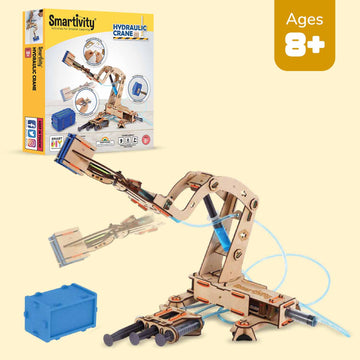
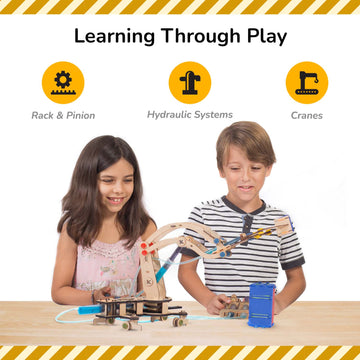
The Hydraulic Crane is one of Smartivity's most celebrated kits — and it earns that status completely. With 256 pieces including real syringes and pipes, children assemble a working crane from scratch that uses actual hydraulic pressure to lift and move objects.
Here's what makes it special: the physics it demonstrates are identical to the physics used in real construction cranes, hydraulic presses, and excavators. When a child pushes a syringe and watches the crane arm rise — lifting a block of wood off the table — they're experiencing Pascal's Law in the most visceral, unforgettable way possible. No textbook can replicate that.
The Hydraulic Crane also introduces rack-and-pinion mechanism — the gear system used in steering wheels and railway tracks — making it one of the most curriculum-dense kits in the entire Smartivity range. Children preparing for Class 6–8 science will find direct overlap with what they're studying. And the kit can be painted or coloured once assembled, extending its creative life beyond the build itself.
What it teaches: Hydraulic pressure, crane mechanics, Pascal's Law, rack-and-pinion mechanism, fluid power.
Best for: Ages 8–14. Birthday gift for engineering-curious children. School project preparation.
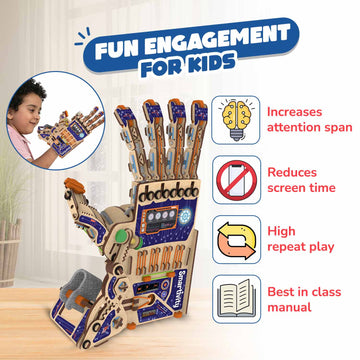
2. Mechanical Hand (Ages 8–14)
The kit that makes children feel like engineers — and a little bit like superheroes.
The Mechanical Hand is Smartivity's Parents Choice Award-winning product — and the moment you see a child operating the hand they built, the award makes complete sense.
Children assemble a fully functional mechanical hand using biomimicry principles — the hand is designed to mimic real human hand anatomy, including tendons, finger joints, and grip mechanics. Once built, children insert their fingers into the finger straps and control the hand's movements directly. It grips. It holds. It releases. It does everything a real hand does — because it's built on the same principles.
The educational depth here is remarkable. Children learn about biomimicry (how engineers draw inspiration from biology), hand anatomy (tendons, bones, joints), gear trains, and mechanical advantage. They understand, physically, why the human hand is considered one of the most sophisticated mechanical structures in nature.
But beyond the science — there's something deeply powerful about a child building a device with their own two hands that their own two hands then control. It's that loop of agency and creation that makes the Mechanical Hand one of the most emotionally resonant kits Smartivity makes.
What it teaches: Biomimicry, hand anatomy, mechanical advantage, gear trains, tendon mechanics.
Best for: Ages 8–14. Boys and girls equally. Stand-out birthday gift. Show-and-tell legend.
3. Electro Play Lab (Ages 8–14)
Where electricity stops being abstract and becomes something you understand in your hands.
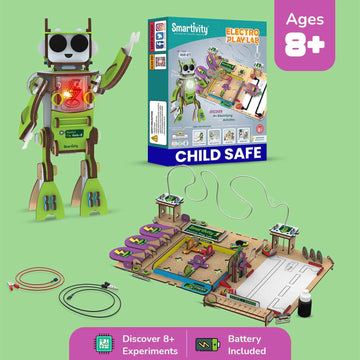
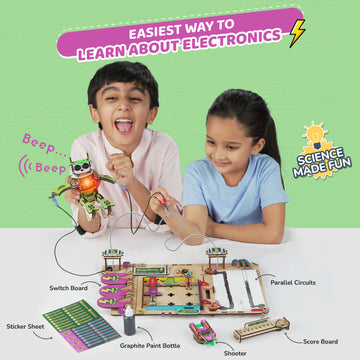
The Electro Play Lab gives children 9 circuit experiments and a DIY electric robot — and it completely transforms how children relate to electricity.
The experiments are designed to be experienced, not just observed. Circuit Painting lets children draw electrical circuits with conductive ink, teaching series and parallel circuits through art. Electricity Maze helps children understand how power grids work and how electricity reaches homes. Buzz Wire is a family game where children navigate a wire without touching it — building fine motor precision and circuit understanding simultaneously. Hit the Target demonstrates how switches work from the inside.
The finished product — a working electric robot with light and sound — is the reward for completing all the experiments. And it's impressive. Children who've built their own robot from a circuit kit understand electronics in a way that years of textbook study can't provide.
What it teaches: Conductors and insulators, circuit types (series/parallel), electricity principles, fine motor skills, basic electronics.
Best for: Ages 8–14. Children with a technical or engineering bent. Ideal for children currently studying electricity in school.
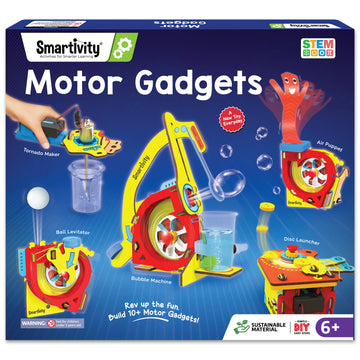
4. Motor Gadgets (Ages 6–14)
One motor. Ten gadgets. Limitless curiosity.
The Motor Gadgets kit is one of Smartivity's most versatile products — and one of the most consistently surprising.
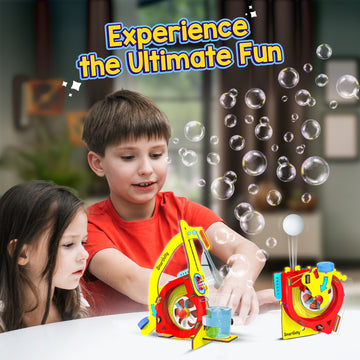
Children build 10+ different motor-powered gadgets using a single reusable motor and a set of modular components. The gadgets include a levitating ball launcher, a tornado creator, a bubble launcher, spinning discs, and more — each one demonstrating a different physics principle using the same core mechanism. Rotational energy, centrifugal force, air pressure — these concepts come alive when a child has built the device that demonstrates them.
What makes Motor Gadgets particularly valuable is the modular design. Children don't build one thing and they're done. They build one gadget, understand it, disassemble it, and build something completely different from the same parts. The kit is effectively ten kits in one — and the habit of iteration and experimentation it builds is one of the most important habits an engineering-minded child can develop.
What it teaches: Rotational energy, centrifugal force, air pressure, electricity basics, engineering iteration.
Best for: Ages 6–14. Exceptionally wide age range makes it one of the best sibling-shared kits. Children who love to tinker.
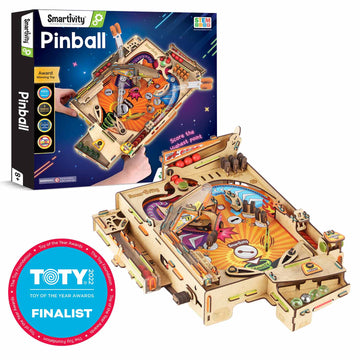
5. Pinball Machine (Ages 8–14)
Why visit an arcade when you can build your own?
The Pinball Machine is a global award-winning kit — and the reason is immediately obvious when you see a child playing the machine they assembled.
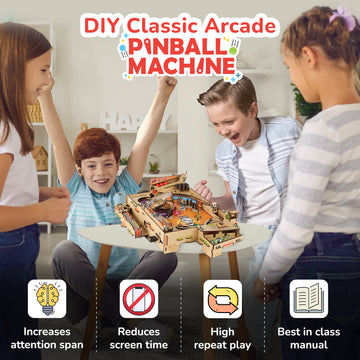
Children build a fully functional, playable wooden pinball machine from scratch. The build teaches levers, momentum, and kinetic energy transfer — all disguised as the pure fun of constructing a classic arcade game. Once complete, it's not a decorative model. It's a real game. Children score points, challenge friends and siblings to beat their high score, and play it again and again.
The Pinball Machine has become one of Smartivity's most gifted products — particularly for boys aged 8–12 — because it sits in that perfect intersection of engineering challenge, genuine play, and impressive finished product. It's the gift that keeps a child off screens because the thing they've built is more engaging than anything on a screen.
What it teaches: Levers, momentum, kinetic and potential energy transfer, mechanical design, cause and effect.
Best for: Ages 8–14. Boys especially, though universally engaging. Ideal birthday gift that doubles as a real game.
6. Foosball (Ages 6–10)
The classic arcade game, reimagined as a DIY engineering project.
Foosball is the kit that makes a room full of children immediately competitive — in the best way.
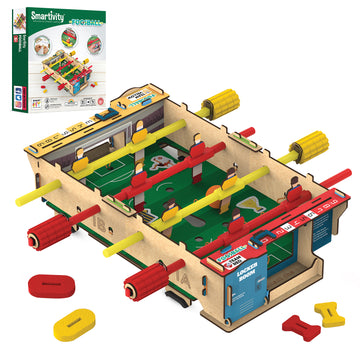
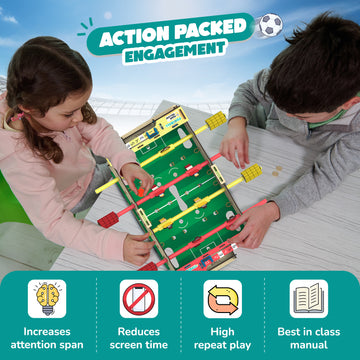
Children build a complete, functional tabletop foosball game with four rows of 360-degree rotating football figures, a mechanical scorecard for each player, and dedicated storage compartments for balls and extra parts. The finished product is a game they can play with friends, siblings, and parents immediately.
The engineering principles are real: children learn about momentum (the ball), speed (the rotating players), and Newton's third law of motion (action and reaction) through direct play. This isn't STEM education as a slow drip. It's STEM education as pure, competitive, exciting gameplay.
For children aged 6–10, Foosball also builds social skills that solo kits can't. Turn-taking, competitive sportsmanship, collaborative celebration, and strategic thinking all emerge naturally through play.
What it teaches: Momentum, rotational motion, Newton's third law, mechanical assembly, social and competitive skills.
Best for: Ages 6–10. Families with multiple children. Children who love football and competitive games.
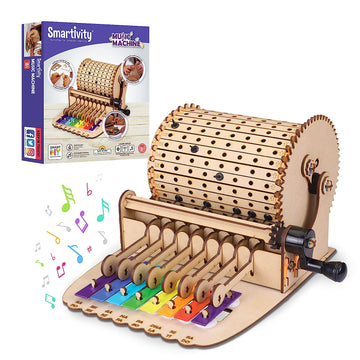
7. Music Machine (Ages 8–14)
For children who want to build their music, not just listen to it.
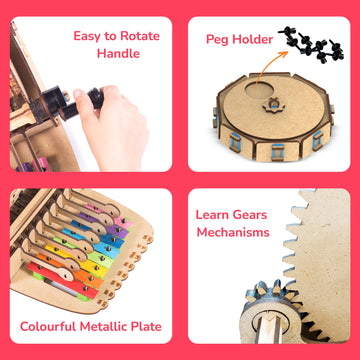
The Music Machine — Smartivity's Xylofun kit — gives children something genuinely rare in STEM toys: an intersection of engineering and music that produces a real, playable musical instrument.
Children build their own xylophone-style music machine from scratch. The build process teaches the physics of sound — how different lengths of material produce different pitches, how resonance works, and how musical scales are rooted in mathematical ratios. These are concepts that appear in both physics and music curricula, and encountering them through building an instrument makes them stick in a fundamentally different way.
But beyond the learning — the Music Machine produces something a child can actually play. Songs, melodies, rhythms. A child who has built their instrument has a different relationship to music than one who simply received one. The understanding of how it works is part of every note they play.
What it teaches: Physics of sound, pitch and frequency, resonance, mathematical patterns in music, acoustic engineering basics.
Best for: Ages 8–14. Children with musical interest. Cross-curriculum appeal — science and music simultaneously.
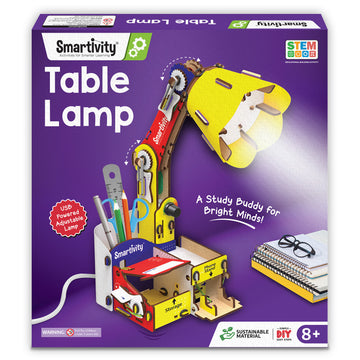
8. Table Lamp (Ages 8–14)
The STEM kit that goes from bedroom project to actual bedside lamp.
The Table Lamp is a newer addition to the Smartivity range — and it represents a specific design philosophy: a STEM kit that produces something genuinely useful in daily life.
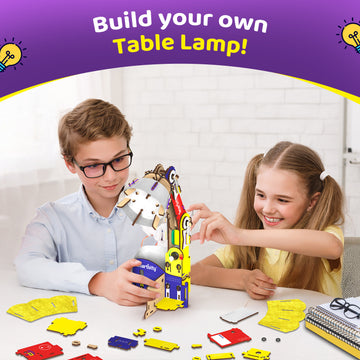
Children assemble a fully functional, USB-C powered table lamp with a 2-pivot adjustable mechanism, a built-in phone stand, and a desk organiser. When they're done, they have a real lamp — one they built themselves — that they can use every evening to read, study, or work.
The educational dimensions are significant. Children learn about electrical circuits (how the lamp is wired and powered), mechanical design (how the pivot mechanism works), and structural engineering (how the lamp stays stable and adjustable). The phone stand and organiser components extend the build into product design — children are creating something genuinely functional, not just demonstrative.
What it teaches: Basic electrical circuits, mechanical pivot design, structural stability, product design thinking, USB-C power systems.
Best for: Ages 8–14. Children who like immediate, practical results from their builds. Excellent desk gift for older children.
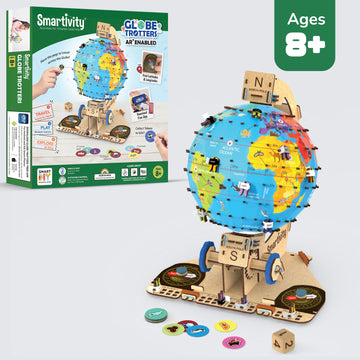
9. Globe Trotters (Ages 8–14)
Build the world. Then explore it.
Globe Trotters is the kit that turns geography from a subject children endure into a world they're genuinely excited to explore.
Children build a 3D globe from wooden sheets — assembling the geographic and coordinate structures that make up a real globe model. Then, using the free Globe Trotters app, they scan any country and unlock interactive quizzes, facts, games, and explorations about that country's animals, monuments, resources, geography, trade routes, and more.
The AR layer transforms a static build into an endlessly dynamic learning experience. A child who has assembled the globe has a personal, tactile connection to it — when they scan Russia or Brazil or India with the app, they're scanning something they made. That ownership changes how they engage with the information.
Globe Trotters is one of the most distinctive products in the Smartivity range precisely because it doesn't fit neatly into a single subject. It's geography, science, history, and culture — experienced through engineering. For a child who asks "why do I have to learn about countries?" — building their own globe is a more powerful answer than any textbook could give.
What it teaches: Geography, coordinate systems, trade routes, day and night cycle, world culture, AR technology interaction.
Best for: Ages 8–14. Children curious about the world. Cross-curricular learners. Gifted learners who enjoy depth.
Best STEM Toys Between ₹1000 and ₹1499: A Gifting Guide
Here's how to match the right kit to the right child.
For the child who loves machines and how things work: Hydraulic Crane or Mechanical Hand. Both produce functional objects using real mechanical principles. Both will be demonstrated to every adult who visits the house.
For the child who's drawn to electronics and technology: Electro Play Lab or Table Lamp. The Electro Play Lab is the deeper learning experience. The Table Lamp is the one with the most immediate, daily-life utility.
For the child who loves games and competition: Pinball Machine or Foosball. The Pinball Machine is primarily solo. The Foosball requires a partner — ideal for children with siblings or lots of friends.
For the child who loves music: Music Machine. There is no other product in this range that serves a musical child this well.
For the naturally curious, multi-interest child: Motor Gadgets or Globe Trotters. Motor Gadgets covers the widest range of physics concepts. Globe Trotters covers the widest range of subjects.
For a child who "already has everything": Any of the above. Most parents don't proactively buy STEM construction kits — they buy them as gifts. Even for a child with a room full of toys, a Smartivity build kit in this range is almost always genuinely new.
The Curriculum Connection: How These Kits Map to School Science
For parents who want to understand how these kits connect to school, here's a direct mapping:
- Hydraulic Crane: Class 7–8 science — force, pressure, hydraulic machines, rack-and-pinion.
- Mechanical Hand: Class 6–8 science — biomimicry, skeleton and joints, gear mechanisms.
- Electro Play Lab: Class 6–8 science — electricity, circuits, conductors and insulators.
- Motor Gadgets: Class 6–8 science — rotational motion, force, centrifugal motion, air pressure.
- Pinball Machine: Class 6–8 science — levers, kinetic and potential energy, momentum.
- Foosball: Class 6–7 science — Newton's laws, momentum, motion.
- Music Machine: Class 8–9 science + music — sound, pitch, frequency, resonance.
- Table Lamp: Class 6–8 science — electrical circuits, current, switches.
- Globe Trotters: Class 5–8 geography — coordinate systems, world geography, trade, day and night cycle.
Every kit in this range actively reinforces what children are learning in school — making them not just toys, but genuine academic tools.
Why Smartivity Is India's Most Trusted STEM Toy Brand in This Range
At ₹1000–₹1499, you're not buying a toy. You're investing in an experience.
Smartivity is an IIT Delhi alumni initiative, made entirely in India, trusted by over 6 million parents across 33 countries. The kits have won multiple global awards — including the Parents Choice Award for the Mechanical Hand and recognition for the Pinball Machine as a global engineering toy. Every product is eco-friendly, non-toxic, and made from premium engineered wood to Indian safety standards.
And every kit in this range — like every Smartivity product — comes with a lifetime free parts replacement guarantee. Not a 30-day warranty. A lifetime guarantee. If any piece breaks, gets lost, or is missing at any point — Smartivity replaces it. No questions. No charge.
You're not buying a cheaper version of something better. You're buying something designed specifically to be outstanding at exactly this price point — for exactly the child it's intended for.
Frequently Asked Questions
- What are the best STEM toys between ₹1000 and ₹1499 for kids aged 8–14?
- Hydraulic Crane, Mechanical Hand, Electro Play Lab, and Pinball Machine are all top picks — complex builds, real physics, and genuinely impressive finished products.
- How long does it take to build a Smartivity kit in the ₹1000–₹1499 range?
- Most kits take 1–3 hours. Complex builds like the Hydraulic Crane and Mechanical Hand take 90–120 minutes. The build time is the education, not just a step before play.
- What does the Hydraulic Crane teach kids about science and engineering?
- It teaches hydraulic pressure, Pascal's Law, and rack-and-pinion mechanics using real syringes. Children lift actual objects — experiencing physics, not just reading about it.
- Why is the Mechanical Hand a good STEM toy for kids aged 8–14?
- It's the only kit that teaches biomimicry and hand anatomy through play. Children control the hand they built with their own fingers — a uniquely powerful engineering experience.
- How does the Electro Play Lab teach electronics to kids aged 8–14?
- Through 9 hands-on circuit experiments — circuit painting, electricity maze, buzz wire — and a DIY robot. Conductors, insulators, and circuit types are all covered through play.
- What is Globe Trotters and how does the AR feature work?
- Children build a 3D wooden globe, then scan any country with the free app for interactive quizzes, facts, and games. Geography meets engineering in one kit.
- Why is Foosball a good educational toy for kids aged 6–10?
- Children build a real, playable tabletop foosball game. It teaches momentum, rotational motion, and Newton's third law through competitive play with friends and family.
- What does the Motor Gadgets kit build and what does it teach?
- One motor powers 10+ gadgets — levitating balls, tornado creators, bubble launchers, spinning discs. Each teaches a different physics concept from the same components.
- How does the Music Machine connect STEM learning and music?
- Children build a functional xylophone and learn how sound frequency, pitch, and resonance work. Physics and music taught simultaneously through building a real instrument.
- What guarantee comes with Smartivity STEM kits in the ₹1000–₹1499 range?
- Every kit includes a lifetime free parts replacement guarantee. Any piece that breaks or goes missing is replaced by Smartivity at no charge, ever.